Listeners:
Top listeners:
-
 play_arrow
YO! 107.1 – Listen Live YO! 107.1

Iran attacks ships in Strait of Hormuz days after Trump gave Tehran ‘a week off’ for Khamenei funeral
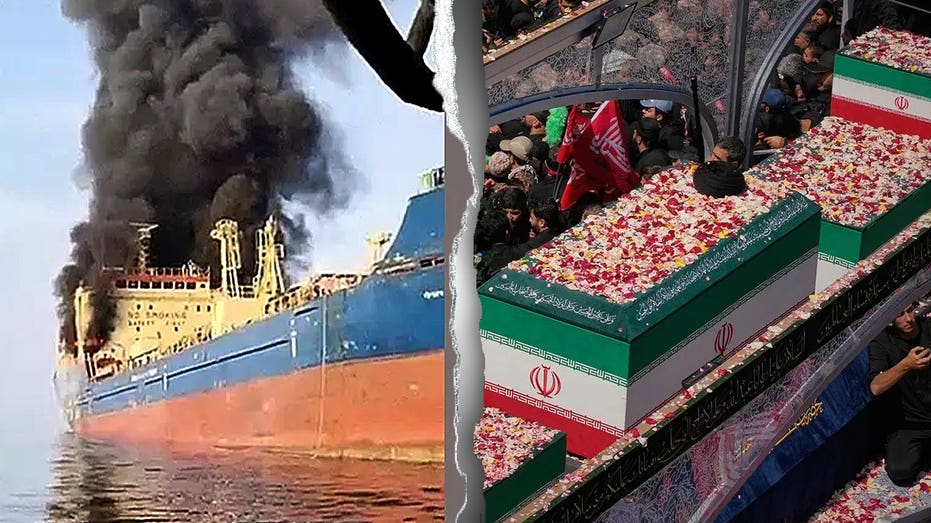
Iran attacked commercial vessels in the Strait of Hormuz Monday and Tuesday, reigniting tensions after President Donald Trump said the U.S. had given Tehran “a week off” during funeral ceremonies for slain Supreme Leader Ali Khamenei.
A U.S. official confirmed that three commercial vessels were struck by Iran in the Strait of Hormuz between Monday and Tuesday.
The attacks targeted commercial shipping transiting one of the world’s busiest maritime choke points. British maritime authorities confirmed a vessel was struck by a projectile near the coast of Oman Monday, while Iranian state media reported the ship had ignored warnings from Iranian forces. The attack reportedly caused a fire on board, but there were no immediate reports of fatalities.
On Tuesday, the U.K. Maritime Trade Operations (UKMTO) reported that another tanker transiting the Strait of Hormuz had been struck by an unidentified projectile. UKMTO said the vessel sustained what was believed to be structural damage but reported no casualties or environmental impact. The agency said it was continuing to investigate the incident and advised vessels transiting the strait to exercise caution and report any suspicious activity.
WALTZ CALLS OUT IRANIAN DIPLOMAT AT UN FOLLOWING DRONE STRIKES ON BAHRAIN AND KUWAIT
The attacks threaten one of the world’s most important energy corridors and raise fresh questions about whether the fragile U.S.-Iran ceasefire can survive long enough for the Trump administration to negotiate a broader peace agreement. Roughly one-fifth of the world’s seaborne oil passes through the Strait of Hormuz, making any disruption to commercial shipping a potential risk to global energy markets and U.S. strategic interests.
That followed two ships being hit Monday.
A U.S. official confirmed one ship hit Monday as the Al Rekayyat, a Qatari liquified natural gas carrier. Iran acknowledged the attack, with state media saying the tanker ignored “repeated warnings” and continued to transit along the southern route of the strait near Oman with U.S. assistance.
A second vessel, the Saudi-flagged crude tanker Wedyan, also sustained damage near the Strait of Hormuz, a U.S. official confirmed. The cause of the damage was not immediately clear, and Fox News Digital has reached out to the vessel’s operator, Bahri, and the Saudi Embassy in Washington for comment.
The White House and the Pentagon did not respond to a request for comment. Central Command, which leads military operations in the Middle East, declined to comment.
The renewed attacks also cast doubt on the Trump administration’s diplomatic strategy. Just days earlier, the White House had paused negotiations while Iran observed funeral ceremonies for slain Supreme Leader Ali Khamenei in hopes of resuming talks after the mourning period concluded.
Speaking during a Fourth of July address at Mount Rushmore, Trump said Iran was “dying to settle” after months of military pressure and declared the U.S. had given Tehran “a week off for a funeral because we’re nice.”
Trump did not elaborate on what the pause entailed, but U.S. and Iranian officials had delayed negotiations until after the conclusion of Khamenei’s multi-day funeral procession, which is scheduled to end with his burial in Mashhad.
Monday’s attack on commercial shipping raises fresh questions about whether the diplomatic opening Trump described can survive renewed hostilities in one of the world’s most strategically important waterways.
Iran has insisted it should play a leading role in managing traffic through the Strait of Hormuz and has sought to collect fees from commercial vessels transiting the strategic waterway. The Trump administration has rejected that position, insisting the strait remain open to free international navigation.
In recent days, Iran warned that commercial tankers using routes not approved by Iranian authorities would face a “forceful response,” and the latest strike comes after multiple attacks on commercial shipping since the U.S.-Iran conflict began earlier this year.
The latest attacks are the newest test of the fragile ceasefire established under a memorandum of understanding signed in June that launched a 60-day negotiating period aimed at reaching a broader peace agreement between Washington and Tehran. The accord called for reopening the strait during the negotiations and an end to military operations while the two sides negotiated a final deal.
On June 25, Iran attacked the Singapore-flagged cargo ship M/V Ever Lovely with a one-way drone while it was transiting the Strait of Hormuz along the Omani coast, prompting U.S. retaliatory strikes on Iranian missile, drone and coastal radar sites. U.S. Central Command called the attack “a clear violation of the ceasefire.”
Commercial traffic through the Strait of Hormuz had begun to recover in recent days following the U.S.-Iran ceasefire, though shipping remained well below historical levels. Ship-tracking firm Kpler reported daily traffic had stabilized at roughly 30 to 60 vessel crossings, down from around 140 per day prior to the U.S. offensive against Iran known as Operation Epic Fury.
Latest Political News on Fox News fc692b3c-9285-5e11-885b-927a3e956351, fnc, Fox News, fox-news/politics/defense/wars/war-with-iran, fox-news/us/military, fox-news/world/world-regions/saudi-arabia, fox-news/world/conflicts/iran, fox-news/world/trade, fox-news/energy, fox-news/politics, article

Latest Posts
FAA issues ground stop at Miami International Airport due to disabled aircraft

NFL Commissioner Roger Goodell Receives Extension, Keeping Him In Job Through 2030

Trump admin’s mail-in ballot fight lands back at Supreme Court

Sydney Sweeney, Brittany Snow and Nina Dobrev turn heads at Venice Film Festival: Vote for your favorite looks

Georgia woman celebrates 112th birthday, reveals her secret to a long life
Current Show
Upcoming shows
Slomin’s